
It was not that long ago that states were competing to win the roof-top solar race. Now, as evidenced by, among other examples, Wisconsin’s recently-approved net energy metering (NEM) fixed-charge increase and Hawaii’s shift toward post-net metering rate structures, it seems like many states are pulling back on the reins. Few states have pulled back harder on net metering than Nevada, where a set of recent orders has disrupted the state’s residential solar industry to a far greater extent than any other.
Author Archives: adrienneladd
Adrienne Thompson Wins 2016 Grodsky Prize
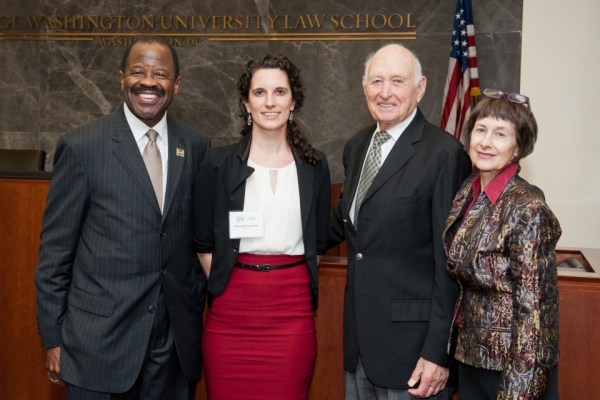
March 17, 2016
This spring, GW Law presented current LLM student Adrienne Thompson with the 2016 Jamie Grodsky Prize for Environmental Law Scholarship. Awarded each year for the best paper written by a JD, LLM, or SJD student in the field of environmental law, the prize commemorates the innovative environmental research of Professor Jamie Grodsky, who passed away in 2010.
Ms. Thompson, who also serves as the Energy Law Scholar and Senior Research Associate for the Energy Law Program, originally submitted her paper as part of an Environmental Law Seminar she took in the spring of 2015. Titled “Predicting the Energy Future by Creating It,” the paper describes a series of strategies that state public utility commissions should pursue to promote sustainable energy policies.
On the day of the ceremony, Dr. Gerold Grodsky and Andrea Huber, Jamie Grodsky’s father and sister, helped present the award to Ms. Thompson. Dr. Grodsky funds the prize along with memorial gifts from generous donors.
“I remember attending the Grodsky prize ceremony for Jason Hull in the Spring of 2015 and being very impressed by Professor Glicksman’s moving tribute to Jamie Grodsky and the legacy she left behind as an academic, friend, and daughter,” Ms. Thompson said after being named the winner. “So, being the recipient of an award in Jamie’s memory is not only a tremendous honor, but it also sets a high standard to strive for as I move forward in my own career.”
About “Predicting the Energy Future by Creating It”
“Safe, abundant, and reliable electricity is the bedrock upon which the United States has built its modern economy. Our national security, commercial activity, and day-to-day living depend on the stability of the nation’s electric system – a system facing a set of challenges unmatched by any other in the grid’s century-long history. Stringent environmental regulations, climate change concerns, waves of older generator retirements, protracted natural gas market dominance, third-party competition, as well as increasing renewables and demand-side technology integration are just some of the realities coalescing into the perfect storm for electric utilities and regulators. Although intimidating, these challenges must be addressed. With their experience and duty to regulate in the public interest, state public utility commissions (PUCs) are well- positioned to help solve these problems and guide our transitioning electric system toward a low- carbon future.
To that end, this paper explores how PUCs can influence this evolution and promote sustainable energy goals, especially in the realm of generator selection. It begins by taking the reader through the changes taking place in the electric industry today, setting the stage for why state-level action is necessary, then briefly summarizes the development of the electric system as well as federal and state regulatory schemes. With that background information as context, the latter half of the paper sets out various options for state PUCs to pursue in advancing a sustainable energy agenda. The difficulties facing electric utilities and regulators today bring with them a host of uncertainties about how our electric system can cope in the near-term and thrive in the long-term. However, by embracing the opportunities inherent in this transition to a 21st century grid, state regulators can prepare for tomorrow’s energy future by helping to create it today.”
For more information see: https://www.law.gwu.edu/adrienne-thompson-wins-2016-grodsky-prize
The Growing Popularity of Community Solar
As the U.S. electricity sector evolves, battle lines have been drawn on such issues as net metering, renewable portfolio standards, and distributed generation. One emerging trend being cheered across the board is community solar. Unlike typical net metering arrangements — in which customers offset their electricity bill through electricity generated by solar panels installed on their own roofs — community solar projects are physically separate from the customers’ property, and each bill is offset in proportion to a customer’s ownership stake in the development. Utilities are jumping on board with these projects, as they are seen as an alternate revenue stream in an age of declining demand and competition from third-party providers. Indeed, according to a November 2015 report from the Solar Electric Power Association (SEPA), there are at least 68 active community solar programs in the U.S., nearly 60% of which are led by utilities, co-operatives and other public power entities. Consumer advocates also praise community solar as a means through which non-homeowners, and lower-income customers, can participate in the country’s solar power revolution. Continue reading
Part II of IV: Short and Long-term Solutions for Struggling Commercial Nuclear Energy Generators in Restructured Wholesale Markets
Background on the History of Commercial Nuclear Power Generation in the U.S. and How Restructured Electricity Markets Developed
To understand how market forces currently threaten the viability of nuclear power generators, it is important to know how the electricity sector itself has evolved over the years. Part II of this blog series briefly summarizes the development of the electricity sector, from the early advent of public utility law and cost-of-service regulation, to the expansive restructured wholesale markets through which most Americans receive their power. With that background, subsequent subsections discuss the particularities of nuclear power generation and how it fits into, and is struggling because of, these wholesale market structures. Continue reading
Part I of IV: Short and Long-term Solutions for Struggling Commercial Nuclear Energy Generators in Restructured Wholesale Markets
Although the U.S. nuclear power industry has struggled to regain footing in the aftermath of Three Mile Island and Fukushima, nuclear power nonetheless plays a critical role in the nation’s electricity sector and will be a necessary resource to utilize in the struggle to reduce carbon emissions and combat climate change. Aside from concerns over finding a permanent waste storage solution, an increasing worry for industry members is how high-cost – but emissions-free – nuclear power is being undercut by low-cost natural gas in restructured wholesale power markets. Without a long-term market-based mechanism to account for the environmental and grid-stabilizing benefits provided by nuclear power generation, America risks losing this important, carbon-free, source of base load generation. Over the course of the next few months, I will upload a series of posts discussing some potential long-term market-based solutions to put nuclear energy on a level playing field, and furthermore argues for a nuclear feed-in tariff as a short-term solution for states with the most financially vulnerable nuclear energy generators.
Going it Alone: Potential Interstate Problems of Intrastate Clean Power Plan Compliance
As evidenced by the 27 states that are suing the EPA, the agency’s recently-finalized Clean Power Plan(CPP) is controversial to say the least. In addition to the legal challenges facing the rule, there are also concerns over grid reliability posed by the large number of coal-fired generator retirements anticipated in the near term. Although much ink has been spilled on analyzing the Clean Power Plan, aside from discussions over grid reliability, little attention has been paid to other potential interstate effects posed by intra-state CPP compliance efforts, and vice versa. Despite the pitfalls posed by discordant state implementation plans within a region, the CPP nonetheless does not require regional collaboration. As argued in this essay, however, by failing to collaborate, states may not only put their own and neighboring states’ CPP compliance plans at risk, but also jeopardize existing and future regional electric system planning efforts.
Continue reading
Continue reading
“So What’s the Horror Here of Concurrent Jurisdiction?”
As readers are likely well aware of, this month the Supreme Court heard oral argument in FERC v. Electric Power Supply Association. The ultimate result could decide the fate of the nascent wholesale demand response sector, but at a deeper level, the case raises important questions about how well equipped the Federal Power Act is to facilitate innovation, integrate new technologies, and allow for cross-jurisdictional electric system planning.
“What Is The True Nature Of A Sale That Was Never Made?”
An Existential Dilemma Arrives at the Supreme Court
On Wednesday, October 14, the Supremes will hear oral argument in Electricity Power Supply Association v. Federal Energy Regulatory Commission. The ultimate result could decide the fate of a nascent cleantech industry aimed at promoting efficiency, lowering prices, and reducing greenhouse gas emissions. More fundamentally, though, this case raises important questions about the federalism underpinnings of the U.S. electricity sector, and how well they can adapt to the new energy evolution underway today.
Protecting Low-Income Ratepayers as the Electricity Industry Evolves
A common understanding among all electric utility reform efforts is that significant investment in our energy infrastructure is needed. In today’s age of flattening electricity demand, expanding DER integration, carbon constraints, cybersecurity and physical threats, and cheap natural gas, electric utilities can no longer rely on building new central generating plants and selling more and more kilowatt-hours to generate profits and support the cost of maintaining and improving the system.
These realities are fundamentally changing the way that electric utilities will be operated and regulated, and several states, like New York, Minnesota, Massachusetts, and Hawaii, have begun investigating how to prepare for and guide this evolution. At the forefront of this discussion are important issues like how to change utility business models and pricing structures, both of which are being actively examined in New York’s REV proceeding and the stakeholder-led e21 Initiative in Minnesota. Every reform effort around the country also includes a recognition that the system of the future must continue to deliver universal, reliable and affordable service. One under-examined issue, however, is just how radically these changes will affect the most vulnerable in our communities — specifically, low-income ratepayers — and how we will protect them.
This article is an excerpt from a larger on-going research project from GW Law’s Sustainable Energy Initiative. Although we are only introducing the project in this article, the ultimate goal of our research is to highlight what policies both protect low-income ratepayers and complement the larger Utility 2.0 reform process taking place across the country.
Scope of the Low-Income Problem
According to the U.S. Census Bureau, 46.7 million people were in poverty in the United States in 2014 — nearly 14.8 percent of the population. But those numbers tell only part of the story. Generally, although each state- and utility-run low-income assistance program defines “low-income” differently, most peg eligibility to certain thresholds at or up to 200 percent of the federal poverty level (FPL) — which expands the total number of eligible enrollees for low-income assistance programs by some 10.6 million people.
In the context of energy assistance, many programs look to not only a person’s income in relation to the FPL but also his or her total “energy burden” — that is, the percentage of a customer’s income spent on energy. According to various resources, like the federal Energy Information Administration middle-income and high-income ratepayers have a one to five percent energy burden, whereas low-income customers face burdens from 10 to 30 percent or more depending on the state.
Sample State Comparison of Energy Burden and Number of Households in 2014 in Relation to the Federal Poverty Level
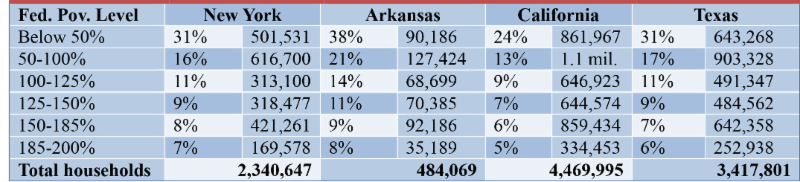
Although the above table highlights only four states, it is clear that millions of Americans struggle to pay their energy bills. And the closer a household is to the federal poverty level, the more onerous that monthly energy bill is. This problem manifests itself in millions of service terminations every year, as well as hundreds of millions of dollars in unpaid bills owed to utilities. So what policies are in place to assist low-income ratepayers, and how well are they working?
Programs and Policies to Assist Low-Income Ratepayers
States and the federal government have various tools available to help low-income households with their energy burdens. At the federal level, two important initiatives are the Low Income Home Energy Assistance Program (LIHEAP, discussed further below) and the Weatherization Assistance Program — both of which are federally-funded grant programs administered in every state, the District of Columbia, as well as most tribal reservations and U.S. territories. State governments also have a broad selection of programs, but the primary mechanism for helping low-income individuals is through the utility rate structure itself.
1. Low Income Home Energy Assistance Program (LIHEAP)
Since funding began in 1981, LIHEAP has become a critical lifeline for some of the country’s most vulnerable members. However, due to budgetary constraints, LIHEAP funding has been cut considerably, from $4.7 billion in 2011 to $3.4 billion in 2014 — which directly impacts the number of funding recipients. In concrete terms, here are those same states again, when factoring in LIHEAP eligibility cap of 150% of FPL.
Sample State Comparison of Total Poor and Low-Income Households
and LIHEAP Coverage

For each of the above states, there is a wide gap between how many households qualify for LIHEAP and how many receive coverage in the form of heating or cooling assistance. Indeed, of the roughly 28,780,463 households that met the LIHEAP eligibility requirement in 2014, only 2,985,747, or 10.3%, received assistance. So, if only a small percentage of low-income ratepayers receive LIHEAP assistance, how are the others getting by and how can we both ensure their protection in the future, and potentially broaden coverage to others in need?
2. Ratemaking
Aside from programs like LIHEAP, the other policy tool for assisting low-income ratepayers is through the utility rate structure itself. Although there are about ten different categories of rate structures used by the states, they essentially all boil down to a subsidy paid for by industrial and other residential ratepayers. In essence, by imposing slightly higher rates on industrial, commercial and non low-income residential customers, utilities are able to deliver electricity to low-income customers at rates that are oftentimes below the actual cost of the electricity service.
For example, in the typical increasing block rate, higher rates are imposed on high-usage customers (read: industrial ratepayers), and rates for other customer classes also rise with consumption.
Standard Inclining Block Rate
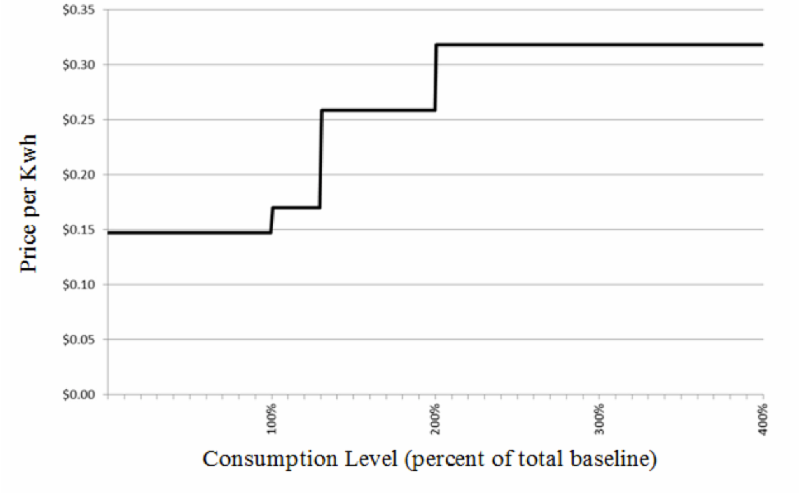
One of the criticisms of the conventional block rate utility rate structure is that it does not so much target low-income customers as low-usage customers — many of whom may not necessarily be low-income. As such, usage-based rates may be over-inclusive, thereby diverting resources away from low-income customers who, because of poor home weatherization or large household size, are not low energy users, and applying them to low-usage customers who do not require subsidization; and potentially sending false price signals that fail to incentivize energy efficiency that would be societally beneficial.
As reported in a recent Electricity Journal article, a helpful illustration of this can be found in the results of a recent study conducted by a medium-sized utility in Oregon. The utility sought to answer the question of how well low-usage corresponds with low-income, and the results were surprising. When the utility analyzed its entire residential load according to various usage categories, it found that its low-income customers were spread out among various usage levels, just like the larger residential class. With only ten percent of the utility’s total residential class being low-income that meant that the utility’s block rate structure “was helping about nine times as many customers as intended.”
To the extent that conventional utility rates worked well at subsidizing low-income customers — a disputed point, as noted above — it was primarily because such rates were implemented in an era of increasing electricity demand and grid-dependence. However, as mentioned at the outset of this piece, today’s electricity sector faces just the opposite set of challenges: demand is falling and more residential and industrial customers want to self-generate, which puts more pressure to subsidize low-income customers and maintain the entire system on a dwindling group of ratepayers.
In the coming months, GW Law’s Sustainable Energy Initiative will be exploring this issue more thoroughly and preparing a set of policy solutions. As utilities and regulators endeavor to adapt to these new realities, they will have big problems to solve: How will utilities earn revenue despite falling demand and customer-side distributed generation? What regulatory policies will be required to ensure sustainable, equitable, forward-thinking development? As new policies and regulatory models emerge from these discussions, it is also important to remember that this evolution will especially affect those in our community who are the most vulnerable to the changing status quo.
Millennial Consumers and Energy Users
|
America’s “Millennial” — or “Gen Y” — generation has been a popular topic of discussion, and it’s not hard to see why. Encompassing those born roughly between 1980 and 2000, Millennials are the country’s largest generation by population size (nearly 80 million people, or one quarter of the U.S. population), and are just now coming into their own as trend-setters, political mobilizers, and — as explored here — energy consumers. As a generation, Millennials have been identified by their digital connectivity, affinity for #selfies and social media, and tireless optimism in the face of bleak economic prospects. According to the Pew Research Center, one-third of Millennials have a four-year college degree or more and about 43% identify as non-white — making this generation the most educated and racially diverse group in U.S. history. On the one hand, researchers have described Millennials as noncynical, civic-minded, and politically active, while on the other, additional studies have shown them to be inwardly-focused, apathetic toward politics and social issues, and, perhaps surprisingly, the least environmentally-minded of any previous generation. Whether this cohort will ultimately be known as “Generation We” or “Generation Me” remains a driving question behind the ever-expanding body of research into the Millennial psyche. Meanwhile, data on the group’s consumer habits is much more straight-forward — providing useful insights for businesses interested in this multi-billion-dollar market, and giving electricity utilities a glimpse at what their future ratepayers value. Millennials as Consumers and Energy Users:
|


You must be logged in to post a comment.